Clean My Excel: A Smarter Way to Clean Messy Spreadsheet Data

A Simple Way to Clean Up Your Excel Data
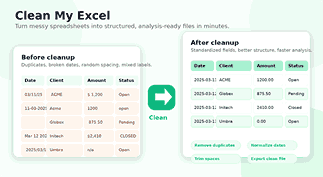
We’ve all been there, looking at a messy Excel sheet and not knowing where to start. The good news is that cleaning up your data doesn’t have to be hard. Your spreadsheet will be clean and ready for analysis in no time if you follow these simple steps: remove extra spaces, get rid of duplicates, and use useful features like “Text to Columns.”
Clean my excel tool turning a messy spreadsheet into a clean structured file.

Why people search for “clean my excel”

People don’t type “clean my Excel” into search engines because they want their spreadsheets to be clean. They look for it because a file that should only take five minutes to open suddenly takes half a day. The dates are no longer the same.
 
Duplicates mess up the totals. If a row is empty, filters won’t work. There are three ways to get names. First, a strong page must deal with that anger. People who need help don’t want to hear another technical lecture, so it should sound helpful, calm, and useful.
 

Messy spreadsheets cause costly delays.

Every step that comes after a dirty spreadsheet takes longer. When records are identical, formatting changes from row to row, and columns contain hidden spaces or broken values, teams can’t trust reports.
 
Even a minor issue with cleanup can mess up dashboards, forecasts, and customer lists. That’s why “clean my Excel” is a real business term. People want a tool that quickly removes friction so they can move on with data they can trust.
 

Cleaning up by hand seems easy until the file gets bigger.

A lot of people start by making a few small changes. They removed one duplicate block, changed the format of one date, and cut one column. After that, the file keeps getting bigger, and the same job gets boring, dangerous, and slow.
 
Hand cleaning works for small sheets, but not when speed and accuracy are important. If you search for “clean my Excel,” the best way to clean it up is to structure it rather than edit it by hand.

What a modern Excel data cleaner should do

A good Excel data cleaner should be able to do the same things that real teams do every day. It should remove duplicates, fix empty rows, standardize numbers and dates, reshape columns, and produce a ready-to-use file. It should also look nice. People want clear actions, easy-to-see results, and a workflow they can rely on. When your content explains those results in simple terms, it fits with what people are looking for and helps conversions.
 

Clarity is more important than speed

Tools that are quick get people’s attention, but tools that are clear get their trust. People don’t just want a quick answer. They want to know what changed, why it changed, and how to fix a mistake if needed. That’s why things like preview, sorting, undo, redo, and reset are important in a “clean my Excel” experience. They help people feel less anxious, more confident, and like the page is useful for both new and returning visitors.

Clean my excel without formulas or technical setup

This topic is very popular because many people who look for it want answers without having to learn macros, formulas, or Power Query. They want to be able to upload a spreadsheet, fix the problems, and then export a cleaner version in just a few minutes. That should be the first thing people see when they go to your page. Be clear about what you promised. Show that users can clean up Excel data online, fix common spreadsheet problems, and avoid complicated setup, all from one place, without making cleanup a training project.
 

Remove duplicate entries early to keep your reports accurate.

Duplicate rows can mess up customer records, inflate your counts, and skew revenue totals. A good ‘clean my Excel’ page should show how to remove duplicate values and explain why it matters. Don’t just list ways to find duplicates—show how cleaning up your data leads to clearer lists, better totals, and more useful reports. Connecting these steps to real business benefits makes the page easier for people and search engines to understand.
 

Quickly fix empty columns and blank rows.

Blank rows and columns are common when importing, copying and pasting, or editing a spreadsheet with others. They look harmless, but they break filters, make things look weird, and make analysis harder than it needs to be. Good content should explain this issue clearly and simply. People know it right away because they see it every day. You make the page more relatable and more likely to convert by explaining how the tool gets rid of that clutter.
 

Make dates, numbers, and text the same for easier analysis.

Inconsistent formatting is one of the main reasons spreadsheets seem unreliable. One column could have three different date formats, different currencies, or names written in different cases. A dedicated spreadsheet cleaner makes sure that the structure is the same before the analysis starts to fix that. Your content should stress that standardized data is easier to sort, filter, group, and see. In a natural way, that message supports the secondary keywords “clean Excel data online” and “Excel data cleaner.”

Why browser-based cleaning feels easier for most teams

Browser-based tools make things easier for busy users who are afraid of them. There is no difficult set up, no technical setup, and no long onboarding process. People open the page, bring in the file, clean up the data, and send it back out.
 
That simplicity is important because the search intent behind “clean my Excel” is clear from the start. Users already have a cluttered file. They want a tool that solves the problem without making the job harder.
 

When spreadsheets have private information, privacy is important.

An online spreadsheet often has contact information, operational numbers, prices, or records for the company. That’s why private messaging is important on this subject. Say clearly and early that your tool processes data in the browser. People who come to the site want to be sure before they upload anything.
 
The page is also better because it talks about a real user concern. Trust is not an extra thing in SEO. It directly leads to more engagement, more confidence, and more conversions.
 

A more organized workflow makes it easier for non-technical users to get things done.

Not everyone who uses Excel is an analyst, and not every team wants to learn advanced features just to fix data problems every day. Sales teams, operations staff, assistants, agency teams, e-commerce managers, and finance users should all be able to easily use a good “clean my Excel” page.
 
The solution is easier for people to understand when the copy is clear. Good business SEO content should make things more interesting without losing their usefulness.

How to clean Excel data online in a simple workflow

The best pages in this area don’t hide how they work. They make it clear how the work will go. First, bring in the file. Look at the sheet. Do the chores that need to be done. Check out the result. Send out the cleaned file. That sequence sounds simple, and it is. That simplicity works. People who go to a “clean my Excel” page want a quick way to think about things. If you give them one right away, the page will look more trustworthy and be easier to use.
 

First, upload the file and check out how it is set up.

The first step in any cleanup job is to understand the file. The user should be able to import data from XLSX, XLS, CSV, or TXT files, switch sheets if needed, and review the structure before making changes. This step might seem small, but it sets the tone for the whole thing. Good copy should focus on visibility and control here. People trust tools more when they can see the sheet clearly before they start cleaning.
 

Put the cleaning steps in the correct order.

The first step in a smart cleanup flow is to fix the problems that are easiest to see. Remove rows that are empty. Get rid of columns that are empty. Cut out the spaces. Put together spaces that happen again and again. Then do things like normalizing, removing duplicates, and making changes. Your writing should teach that order without sounding like you’re preaching. People like getting help when it saves them time. This also increases the dwell value because the page does more than just sell a tool. It helps readers learn to clean up messy spreadsheets more easily.
 

To be sure of what you’re doing, use the “undo” and “redo” buttons.

People don’t want to clean data because they’re afraid it will ruin the original file. That’s why the copy should pay close attention to redo and undo. These features make the tool safer to use than a dangerous editor. They let users test things out, undo changes, and make things better without getting mad. This page is easier to use and more reliable because it clearly states this. It also makes the tool different from basic cleaners that use a single blind process and hope for the best.
 

Export a file that’s ready to use in the next step.

You can’t finish cleaning up until your data is in a usable format. That’s why exporting deserves more attention. People want a clean XLSX or CSV file they can share, review, or use in another workflow right away. Good writing should connect cleaning up with taking action. Instead of just saying, “We did it,” show what it means in practice: faster reporting, fewer mistakes, easier teamwork, and a smoother move to the next system.

Key features of CleanMyExcel

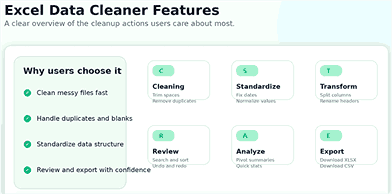
Excel data cleaner features overview with cleaning, standardization, review, analysis, and export actions

Eliminate invisible clutter and trim spaces.

Spreadsheets frequently contain hidden characters, leading spaces, and trailing spaces from manual entry and exports. They break filters, produce false mismatches, and reduce the accuracy of duplicate detection. That should be handled in a matter of seconds by a specialized Excel cleanup tool. This should be described in your copy as a quality fix rather than a small cosmetic adjustment. Cleaner sorting, cleaner searches, and more reliable records throughout the worksheet are all made possible by clean text fields.
Normalize labels, categories, and names.
 

Normalize labels, categories, and names.

“New York,” “New York,” and “NEW YORK” may appear in one file as distinct values. Product categories can differ based on spacing, spelling, or casing. Pivot outputs are messy, and analysis is weakened by this inconsistency. It is easier to rank for intent-rich secondary phrases like “standardize spreadsheet data” and “fix messy Excel file” when the page explains proper case, upper- and lowercasing, and text normalization in plain English.
 

To improve structure, divide and combine columns.

Bad column design often hides messy data. One cell has full names in it. Too many columns contain address fragments. Values and labels are crammed together. Users can merge specific fields, split columns by separators, and reshape the file for a cleaner structure with the aid of a powerful spreadsheet cleaner. This goes beyond practicality. It distinguishes a sheet that facilitates actual analysis, filtering, and reporting from one that merely stores data.
 

To make the dataset make sense, rename the headers.

Clear headers save time every time someone uses the file. If the column names on the sheet are unclear, broken, or repeated, it is harder to find your way around and trust the data. When writing well, you should explain header cleanup as a way to make things faster and clearer. Renaming columns makes the export easier to use for the current user and for future imports, as well as for colleagues and analysts. That small action makes a big difference in real-life workflows.
 

Sort, search, and preview without losing speed

Many of the people who come want to do more than just clean the file. They want to look at it while they work. You can do that without having to switch tools because there are built-in controls for searching, sorting, and previewing. This is worth mentioning because it makes things run more smoothly and keeps people interested for longer. Visitors would rather stay in one workflow from import to export. A copy that highlights this benefit shows that the tool respects how people really work with spreadsheet data in the real world.

Common spreadsheet problems addressed on this page

It’s not always clear how dirty imports can hurt the quality of data.

When you import spreadsheets, they often have characters that don’t print, strange spacing, formatting leftovers from merged files, and broken structures from another system. The file may look fine at first, but as soon as the user sorts, filters, or summarizes the data, things go wrong. Your writing should make that pain clear. It helps people see that their skill level isn’t the issue. The file is a mess, but the right cleaner can make it better.
 

When you mix formats, one column works like three.

A date column can have slashes, dashes, month names, and cells with different text formats all in it. A numeric column can have commas, currency signs, blank spaces, and decimals that don’t always line up. Excel can’t see the column as a single field anymore, so it’s impossible to analyze that kind of change. This page should make the problem clear and show how normalization can help. One of the best reasons to look up “clean Excel data” on the internet is this.
 

When there are empty cells, it takes longer to sort, filter, and report.

Empty cells aren’t always a problem, but they can be when they show up in important fields without any explanation. They make filters less effective, make summaries harder to read, and make it hard to tell if the data is missing or just dirty. Good writing should show how fill-down features, blank cleanup, and better structure can help people feel better about themselves. This makes the page real and useful. People like it when the content talks about the little things that annoy them and waste their time every week.

Analytics features turn cleanup into useful output

The best pages do more than promise a neat file. They show how a consistent dataset helps users create clear summaries, compare categories, and make better decisions. Using analytics terms makes these benefits clear and ties data cleanup to real business results. This link is key for higher rankings and conversions, since users care about measurable improvements, not just cleaner data.
 

Pivot summaries let users find patterns fast.

After cleaning a file, users seek quick answers, such as which category is largest, which customer segment repeats most, or which month has the highest volume. Pivot summaries provide these insights efficiently. If your tool supports count, sum, average, min, and max, the copy should clearly explain these features. Highlighting these benefits broadens the page’s appeal, as many users interested in cleanup also want fast spreadsheet analysis.
 

Charts make cleaned data easier to understand.

Charts turn cleaned data into information that’s easier to scan and share. This helps managers, clients, and teammates who don’t want to look at raw data. Good content should connect charting to communication, not just visuals. Showing how users can clean Excel data online and then present it clearly makes the page more valuable and can boost engagement and conversions.
 

Summary statistics make it easy to check quality quickly.

Users want quick ways to make sure their cleaned file is accurate. Summary statistics give them a checkpoint to review counts, averages, ranges, and other details before digging deeper. Pointing out this benefit makes the page look more professional and trustworthy, showing that the tool helps with both cleanup and quality checks.

Who benefits most from a clean Excel tool

Don’t use technical language; instead, show how messy spreadsheets make it hard for real teams to do their jobs every day. Use examples from real users to get people more interested and make it clear who the page is for. This will help with both SEO and sales.
 

Sales and customer relationship management (CRM) teams need cleaner contact information.

Sales teams keep track of pipeline reports, make partner lists, and export leads. They often have to deal with duplicates, inconsistent capitalization, empty spaces, and mistakes in formatting. Before importing or reaching out, a browser-based Excel cleaner quickly fixes mistakes, removes duplicates, and standardizes these lists. To help teams find the right contacts, follow up more easily, and get more accurate reports, they need to make sure that their data is consistent. These are all important things that will help your revenue operation be successful.
 

The operations and e-commerce teams also need clean data.

The e-commerce and operations teams make sure that the names, SKUs, quantities, prices, and categories of products are all the same. Columns that aren’t lined up correctly can lead to mistakes, delays, and confusion. Catalog and supplier data managers’ systems work better, and they make fewer mistakes when they do things by hand. The “clean my Excel” page should talk about these real-life problems and show how the tool saves time every day by doing less manual work and organizing data on its own.
 

Finance teams also need cleaner worksheets before they can do analysis.

The finance teams won’t accept dates that aren’t valid, numbers that don’t match, or rows that are the same because they can cause problems. By organizing numbers, cleaning up columns, and getting files ready to be exported, teams can save time and make fewer mistakes that need to be fixed by hand. Anyone who wants to be more accurate and make things easier to use can do better analysis, share information faster, and get more done with these tools.
 

Also, getting ready saves agencies, assistants, and researchers hours of work.

There are problems with Excel sheets that affect more than just a few departments. Agencies clean up client exports, assistants update internal lists, researchers check that all the survey results are the same, and analysts get files ready to be reported. Even though they may not think of themselves as data experts, they often have to deal with messy spreadsheets. If you show how the tool quickly cleans, organizes, and standardizes data, people will think it saves time, which will make the page more relatable and fit what people are looking for in a commercial search.

Clean my Excel vs manual Excel workarounds

The page shouldn’t act like most people don’t already know how to do some things in Excel. In simple cases, it should instead understand that filters, formulas, and manual changes can be helpful. Then it should explain why those methods become slow, repetitive, and error-prone when applied extensively. This balanced framing makes it easier for people to trust each other. It respects the reader’s experience while still explaining why using a dedicated Excel data cleaner makes working with messy files faster, cleaner, and more consistent.

Formulas only help with some parts of the problem, not all of it.

One cell pattern, one value type, or one column can be cleaned up at a time with a formula. That’s helpful, but it means the user has to figure out how to clean up one step at a time. Many people who type “clean my Excel” want a simpler way to do it. They don’t want a bunch of weak workarounds; they want everything to happen in one place. Your content should show that the tool is a focused workspace for cleaning up spreadsheets, not just another way to do manual work.

Advanced Excel features are powerful, but they can be hard to use at times.

Power Query and advanced spreadsheet workflows can do a lot of cool things, but they also take a lot of time to learn, which many people don’t want to do for everyday cleaning. The page should make it clear that the tool is the best choice. It gives you useful cleaning power that doesn’t require special skills. That message works especially well for people who are looking for businesses because they often compare their skills and effort. How easy it is to use is one of the things that makes the product valuable.

A simple first-session workflow builds confidence fast

Start with the easy wins in cleaning up.

In the first session, the audience should start with actions that show quick progress. Remove rows that are empty. Get rid of columns that are empty. Cut out the spaces. Make sure that all the problems with the text are the same. This order gives the outcome more momentum and builds trust in it. Your page should explain that method because it makes the reader feel like they can do it right away. The visitor is more likely to finish the workflow if the first step goes well. If the first step makes them unsure, they are more likely to leave.

Change the shape of the file only after the data is stable.

Once the sheet is cleaner, the user will feel more sure about splitting columns, merging fields, changing headers, and making dates or numbers normal. That order is very important. It keeps people from accidentally doing the same cleaning job twice and helps the file go from being messy to being organized in a way that makes sense. It seems smart and well-thought-out to include content that explains this order. It tells readers that the page is more than just keywords. A person who knows how to clean up a spreadsheet made it.

Check the summaries before you export.

Before sending the cleaned file, users should check a pivot, some summary statistics, or a sorted preview to make sure it works. That step keeps mistakes from happening and makes people more sure of the final product. It should be in the article because it is helpful. People who read want more than just words. They want an easy way that they can trust. When the page does that, it becomes more helpful and easier to remember.

Frequently asked questions about clean my excel

Can you clean up Excel data without using any formulas?

Yes. A dedicated cleaner should let you import the file, clean it up, look at the results, and then export a worksheet that is ready to use without having to write new formulas. That’s one of the main reasons people search for “clean my excel” on Google. They want a faster way to get accurate information, especially when the file is too messy for quick fixes by hand.

Does the tool work with files that have more than one sheet, like CSV and XLSX?

A recommended spreadsheet cleaner should be able to clean up TXT, XLSX, XLS, and CSV files. You should also be able to easily switch between sheets in a workbook that has more than one tab. You need to be able to change how your work looks because messy spreadsheets don’t always look the way you want them to. People who want a cleanup tool want one that works with the files they already have, not one that makes them do extra steps before they can use it.

Is there a way to get rid of duplicates, empty rows, and spacing issues all at once?

Yes. Cleaning up that mix is one of the most common things that needs to be done. Users often need to get rid of duplicate rows, trim spaces, combine repeated spaces, and clear empty rows or columns all in the same session. With a good “clean my Excel” tool, you should be able to do those things easily from one place. That saves time and is easier than trying to remember a lot of different ways to fix things.

Is this useful for teams and analysts who aren’t technical?

Of course. The best cleanup tools help analysts get their work done faster, but they also help sales teams, operations managers, assistants, finance staff, e-commerce teams, and agencies that deal with messy files every day. If the workflow is clear and easy to follow, even people who don’t know much about Excel can clean up their spreadsheets with confidence. That wider usability is a big plus for getting people to use the product and making the landing page useful.

Why should you use an online Excel data cleaner instead of editing it by hand?

Cleanup that happens in the browser makes setup faster, keeps the workflow simple, and helps users quickly get from messy files to usable output. They can clean up the structure, standardize the values, review the summaries, and export a better file all from one place. This saves them time because they don’t have to make the same changes over and over again. A lot of teams find that the best answer to the question “clean my Excel” is “how do I fix this sheet quickly without making the job harder?”
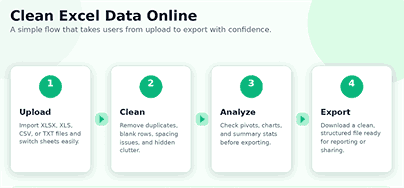
Clean Excel data online workflow showing upload, clean, analyze, and export steps

Final call to action to clean my excel

If your spreadsheet is slow, don’t get more upset and fix it by hand. That’s not the best way to do it. A cleaner workflow is the best answer. There should be a promise at the end of a page that is all about “clean my Excel.” In just a few minutes, tell the user to upload the file, clean up the mess, standardize the data, and export a cleaner version. Check to see if the tone is helpful. A good call to action doesn’t sound like a sales pitch; it sounds like a useful next step.

Scroll to Top