
Free Personal Brand Assessment Tool
Summary of the Personal Brand Assessment Tool
A good way to see how people think of you online
Before you even walk in, your personal brand says a lot about you. You can find it in LinkedIn headlines, Google search results, website copy, podcast bios, speaking pages, and social media profiles. Having a strong personal brand can help you get ahead. People doubt when it’s weak or unclear.
Why this page matters
This page gives you more than just a basic list. It shows you how to use a personal brand assessment tool to check all of your visibility, credibility, consistency, authority, and positioning in one place. It also shows you how to put those ideas into practice.
What this guide will show you
You’ll learn what the tool measures, how scoring works, who should use it, and how to get a higher score. You will also get constructive advice for your website, LinkedIn, your content strategy, and your online reputation.
Why Use a Free Personal Brand Assessment Tool?
It saves time
You don’t have to go through every profile, page, post, and brand element by hand from the start. A free personal brand audit tool will give you a structured starting point in just a few minutes.
It shows areas that are hard to see
Flaws in design are readily apparent to a large crowd. Not as many people can see holes in trust, weak calls to action, thin proof of authority, or confusion among the audience. The tool makes it easier to see the blind spots.
It turns feedback into action
Audits that are effective should not solely provide a score. You should be informed of the subsequent steps. That’s why the best personal branding calculator does more than just give your brand a number. It changes the score into quick wins, channel priorities, and a plan that makes sense.
What Is a Personal Brand Assessment Tool?
A simple definition
A personal brand assessment tool is a structured way to see how people view your professional identity online. It takes brand signals that are inconsistent and turns them into a clear score and a plan for how to improve things.
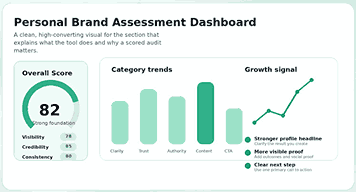
What it looks like
However, an effective personal brand assessment tool does not solely evaluate the external appearance of an entity. It looks at how clearly you explain your worth, how often you show up on different channels, how credible your proof is, and how easy it is for people to find you when they search for you.
Why professionals need one right now
Individuals don’t wait for an official introduction anymore. They can find your name, read your LinkedIn profile, and check out your website in just a few seconds to see if you are trustworthy. This is why you should look at your online personal brand. It helps you find the problems before customers, employees, clients, or partners do.
Why Personal Branding Needs Measurement
Guessing weakens positioning
Plenty of smart people think they have a brand just because they post on social media every now and then. In fact, random activity does not create a unique market position. Measurement gives you facts instead of guesses.
Visibility without clarity does not lead to conversion
You can get people to visit your site but not trust you. If your message is vague, broad, or inconsistent, people will remember how it made them feel but not what it was worth. You can use a personal brand score calculator to see if your clarity is making you more visible.
Signals help you look trustworthy
People trust proof more than statements. Testimonials, case studies, media mentions, featured appearances, portfolio pieces, founder stories, and clear signs of expertise all help to build stronger authority. A tool for analyzing your personal brand can help you find out what credibility assets you don’t have.
Who Should Use This Tool?
Who start their own businesses
When you sell your expertise, vision, or leadership, people often decide whether to buy from you based on your reputation. Investors, clients, the press, and potential employees all evaluate a leader’s trustworthiness. Therefore, founders need a way to build their personal brand.
Who offer services, coaches, and consultants
Your online presence needs to make people less hesitant if your business depends on trust. This tool helps professionals see if their content, social proof, and positioning work together or against each other.
Who make things and come up with ideas
Creators often grow quickly on one platform but don’t pay attention to the rest of their ecosystem. An online personal brand audit helps creators make sure that their content, conversion paths, audience trust, and owned channels are all working together.
People looking for jobs and managers
Recruiters, hiring managers, and people in your industry look at your web presence. A personal brand score calculator can help you figure out if your current online presence is helping you get the job, power, and opportunities you want next. like Improving LinkedIn profiles for people looking for jobs
What the Tool Measures
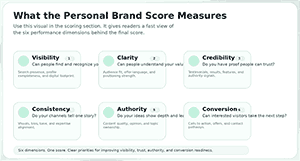
Visibility is how easy it is to find you and know who you are online. It includes how easy it is to find you in search, how complete your profile is, how often you use the platform, and how strong your digital footprint is.
Branding that is clear
Clarity checks if people can quickly tell who you help, what you do, and how you’re different. If your message seems too broad or general, it loses clarity.
Consistency across all channels
Checks to make sure that your bio, profile picture, visual identity, expertise themes, tone, and positioning are the same on all platforms. People don’t trust you as much when your channels tell different stories.
Proof and reliability
Verifies the authenticity of your brand. Proof can come in the form of results, testimonials, client logos, media mentions, certifications, speaking appearances, case studies, or a well-organized portfolio.
Power and leadership
Authority checks to see if your content is knowledgeable, has a perspective, and is deep. It checks if your content is meaningful and trustworthy or just filler.
Ready to change
Conversion readiness checks to see if your personal brand is going in the right direction. If they like what they see, can they move on? It’s important to have clear calls to action, ways to get in touch, lead magnets, booking options, and excellent deals.
How the Scoring Helps You Improve
A score tells you how far you’ve come
Obtaining a score is an advantageous starting point. It enables you to compare the current presence of your brand with the one you aspire to establish within the next three to six months.
The scores for each category show what is most important
The full story is provided by category scores, while a single number is useful. If you possess substantial visibility but lack credibility, you are aware of the appropriate course of action. If your message is clear but your conversion path is weak, you know how to fix the leak.
Plans of action help make things less overwhelming
Most folks don’t require a total brand overhaul. They simply need a more effective arrangement. Rather than attempting to address every issue simultaneously, a personal brand assessment tool can help you determine your next steps.
How This Free Personal Branding Calculator Works
Step 1: Answer questions that are clear
The tool asks good questions about your content, online presence, positioning, proof, and the health of your channels. These questions are meant to find the signals that change how people see things.
Step 2: Check out how your score is split up
After you take the test, you get a score based on the categories. This breakdown not only tells you how strong your personal brand is overall, but it also tells you why it is that way.
Step 3: Look over the ideas you wrote down
The suggestions make the information helpful. You don’t just get general branding advice; you get specific ideas for how to improve based on your current profile and weaknesses.
Step 4: Follow your plan
The best way to get results is to do something. The tool tells you right away what to do, what to change in your content, and what to focus on building your brand over time.
The Best Things About a Personal Brand Assessment Tool
Look at things that are real from the outside
It’s hard to be fair when you look at your brand. You know what you’ve done, what you want to do, and what you want to get out of it. Your audience can only see what’s on the page. A personal brand assessment tool helps you understand that better.
Make your message fit the market better
Being smart doesn’t mean having a better personal brand. It means that it sounds like it matters. People will trust and remember your brand more if your message addresses their real problems.
Make a better first impression online
Initial impressions are typically formed prior to initiating communication with an individual. You can use this tool to improve the things that people see first, like your headline, bio, social proof, content themes, and call to action.
You make the authority loop more powerful
Good positioning leads to better content. Better content builds more trust. More trust means more clicks, referrals, replies, and opportunities. A smart audit can help you make that loop stronger.
Common Personal Branding Issues This Tool Can Reveal
Too much like other people
If your message could fit five other people in your field, you need to work on your positioning. Strong brands are clear, useful, and easy to remember.
The channels don’t match up
The headline on your LinkedIn page and the one on your website might not be the same. Your content may be for one group of people, but your offer may be for another. That disconnect makes things difficult to understand for visitors and slows down sales.
Trust claims instead of proof
Expertise is not a mere assertion. Your brand necessitates evidence that is both visually appealing and corroborates your assertions. Even a lot of experience can seem unconvincing without it.
Don’t think about your brand when you make content
Just because you have many posts doesn’t mean your brand will be strong. If your posts don’t have a clear perspective, content pillars, and audience intent, they’ll seem more like noise than strategy.
You don’t know what to do next
Professionals often put together impressive profiles, but they still have trouble turning leads into sales. It’s clear why. They never give people instructions on what to do next. A personal brand score calculator can help you find these conversion gaps.
How to Improve Your Personal Brand Score
Make your headline clearer by rewriting it
The headline should say what you do, who you help, and what you do. Don’t use vague labels. Be relevant at the top.
Shorten your bio
The bio should be concise, confident, and direct. Instead of just listing your job titles or years of experience, it should show how your skills have helped you get real results.
Your profile picture and other pictures should all look the same
Users remember things better when they are visually consistent. On all of your main channels, use profile pictures that are clear, colors that are easy to remember, and a clean design style.
Put proof where trust is most important
Place testimonials, results, awards, or logos in areas where people make decisions. The featured section on LinkedIn, the sales page, the speaker page, and your website are all excellent places to start.
Build your content on strong foundations
Content should help you get ahead of your competitors. Choose a few topics that you want to write about extensively and in detail.
Make your call to action stronger
Every brand that wants to be strong needs to do something next. Ask people who come to your site to book a call, read a guide, download a resource, sign up, or look around a service page. Make the action clear.
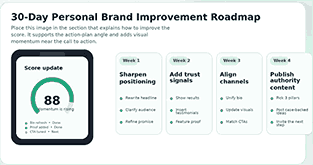
A Practical 30-Day Improvement Plan
Week 1: Get your position right
Start with the basics. Please consider shortening your bio, updating your headline, and clarifying your target audience. Most of the time, these changes make the brand clearer the quickest.
Week 2: proof of the upgrade
Add things like client outcomes, case studies, metrics, media features, or testimonials. Instead of making broad claims, show that you know what you’re talking about.
Week 3: Make the channel more stable
Put your main platforms next to each other. Ensure that all your messages, images, and calls to action tell the same brand story on all your channels.
Week 4: Publish strategic content
Write a short piece that shows what you know. Give people examples, lessons, frameworks, or short case stories that will make them feel more at ease with you.
Why This Tool Beats Static Templates
It lets you interact
Nevertheless, a static worksheet may prove advantageous; however, it is not updated frequently. A personal brand assessment tool takes what you give it and gives you a score that is only for you.
It’s easier to say again
Effective auditing necessitates repeated execution. The tool can be reused to observe the evolution of events over time following updates. This enables you to gauge your progress.
It makes decisions faster
Templates collect notes. Tools send messages. When your scores and suggestions are clear, it’s easier to decide what to fix first.
Personal Brand Assessment Tool vs. General Branding Advice
Advice is inherently expansive
Digital branding tips are designed to assist everyone. That means it stays at a high level most of the time. It tells you to post more, prove your worth, or gain authority, but it doesn’t say where the real gap is.
Assessment gives things a purpose
There is a personal brand assessment tool that evaluates your present circumstances. It examines your current assets, your consistency, the evidence you have, and the opinions of your audience. That context makes the advice more useful.
Being specific gets things done
Specific fixes are preferable to general motivation. If the credibility score of the tool is low, it is recommended that you concentrate on the evidence. You should rewrite your message before making more content if it’s not obvious.
How to Use the Results for Real Growth
Prioritize the impact on business
Don’t waste time on issues that don’t matter. Instead, focus on the aspects of your brand that directly influence trust and customer choices. Typically, these include clarity, evidence, consistency, and a clear path forward.
Ensure that the modifications align with your objectives
To secure speaking engagements, you must project authority and take the lead on your subjects. If you’re seeking clients, then fortify your proof and conversion strategies. And to land job offers, bolster your credibility and professional standing.
Look at your score every three months
The market changes. Your content changes. Your brand should also change. Every three months, doing the audit helps you stay on track with the chances you want to get.
Best Practices for a Stronger Personal Brand
Please explain the exact issue you are dealing with
Some words can help you remember things. It also makes it easier for the right people to see themselves in what you write.
Please let us know what you think
Being able to share your thoughts clearly makes you stronger. Don’t say what everyone else does. Please tell us what you believe, what you don’t believe, and what you’ve learned from working.
Use proof a lot, but be smart about it
Proof should help the trip, not get in the way. Put it where people often stop and think about what to do.
Build on platforms you own
Social media can help you reach more people, but your website, email list, and lead assets keep things steady. Don’t depend on just one platform to build a strong personal brand.
Make sure people can easily understand your brand
Complicated language undermines trust. It’s easier to understand things when you use clear language. People move faster when they can quickly see how useful you are.
Frequently Asked Questions
What makes this different from a personal branding calculator?
Not only does this tool give you a score, but it also gives you context. You can get a number from a personal branding calculator. A better tool will explain what that number means and what you should do next.
Is the calculator useful if I already have a LinkedIn profile and a website?
True. That’s when the tool is most helpful, in fact. When assets are already in place, it’s easier for things to go wrong, messages to be weak, and proof to be missing.
Is this tool simple enough for beginners to use?
Definitely. The audit can help beginners start on the right foot. Fixing a brand that has already suffered is usually more challenging.
How often should I look into my own brand?
The majority of professionals believe that a three-month review is appropriate. If you’re making a new offer, changing your position, or moving into a new market, run it sooner.
Does getting a higher score mean you will get more chances or leads?
No tool can promise results. It can help you make the signals that affect trust, recognition, and action stronger. Better signals mean better odds.
Final Thoughts
You need to organize your personal brand
Strong brands don’t just appear. It gets better when you look at what people see, resolve the problems, and do it again with a goal in mind.
Start with clarity, then keep going
It is not necessary to change everything at once. Begin with the gaps that are easiest to see. Make your message clearer, your proof stronger, your channels more in line with each other, and the next step clear.
The score is the beginning, not the end
The best way to judge your personal brand isn’t just to give it a score. It helps you make it sharper. Use the information to make your online presence more clear, trustworthy, and open to new opportunities.
Discover Smart Tools
Building a strong brand for yourself can be greatly aided by using the appropriate tools.
To improve your professional presence, use a LinkedIn profile optimizer. Then, use a personal brand assessment tool to see how well you’re doing overall. You can also use a meta-CTR booster and a text analyzer to help you write better, which will make your content more visible.
Try out tools like SPSS Lite or Clean My Excel to learn more about how well you’re doing and where you can improve. People’s opinions of your personal brand online can change a lot if you make small changes to your content, visibility, and data analysis.