Trading Position Size Calculator: A Risk Management Tool for Forex, Crypto, and Stocks
Trading Position Size Calculator: A Practical Guide to Risk-Based Sizing for Stocks, Crypto, and Forex
The Importance of a Position Size Calculator
First, exchange constraints: NSE/BSE/PSX tick sizes and broker step rules demand correct rounding.
Additionally, local costs—brokerage, STT/SEBI levies (India), PSX fees (Pakistan), GST, and maker/taker fees (Binance)—change effective risk.
Finally, mixed markets: Many of us rotate between INR/PKR equities, USD cross‑forex, and USDT‑quoted crypto pairs in the same week.
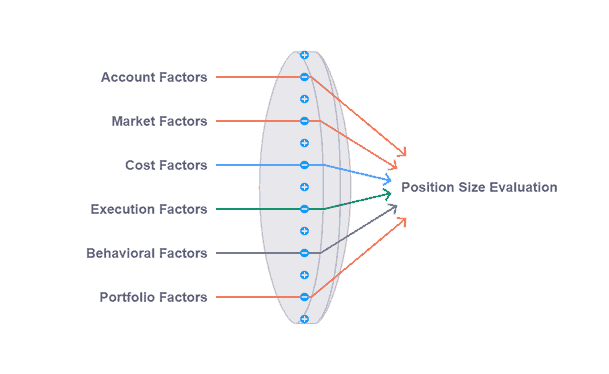
Key Factors Influencing Position Size
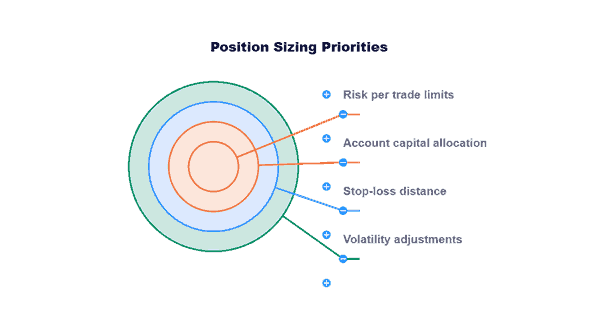
Account equity: I always base position risk on live equity after P&L and fees—not on my original deposit.
Risk per trade: While 0.5%–2% of equity is typical, I favor 0.5%–1% in fast markets.
Stop-loss distance: Per-unit risk is |Entry − Stop|; however, tighter stops increase size but also raise stop-out probability.
Volatility: For this, ATR or standard deviation helps me set realistic stops.
Instrument types: Shares, coins, or forex lots each have their own tick values and contract specifics, which I must consider.
Tick and step sizes: For example, NSE/BSE/PSX and Binance enforce valid increments; thus, calculators must round correctly.
Fees, taxes, and slippage: As a result, these reduce the true risk room and must be included.
Leverage and margin: Therefore, I only use leverage when my stop‑defined risk still fits the budget.
Common Mistakes in Position Sizing
How to Use a Position Size Calculator
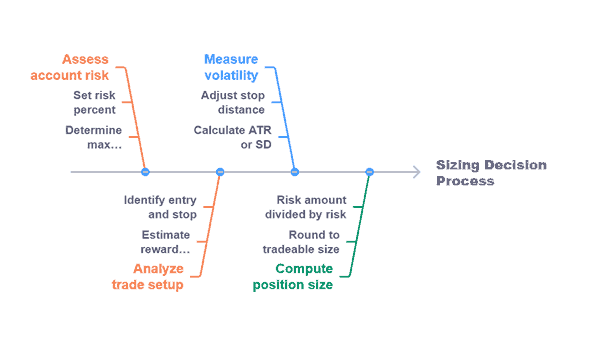
- Define your risk: Select a fixed percentage (e.g., 1%) or a fixed amount in INR/PKR/USD.
- Next, set your entry and stop levels by using structure, ATR multiples, or thesis invalidation to guide this step.
- Afterward, select your instrument—such as stock, crypto, or forex—and confirm the base/quote (e.g., BTC/USDT, EUR/USD).
- Once your instrument is chosen, input the relevant data: account size, risk %, entry, stop, and optionally, a fee or slippage buffer.
- With your data entered, review the output: you’ll see quantity and notional exposure, rounded according to exchange rules.
- Finally, use your calculated details to place protected orders. Implement OCO or bracket orders so the stop is live from the beginning.
- Dollar risk per trade = Account equity × Risk %
- Per-unit risk = |Entry − Stop|
- Position size = Dollar risk ÷ Per-unit risk
Calculate position size by converting pip distance to currency value using the pip value for the specific currency pair. Use a standard lot (100,000 units), mini lot (10,000 units), or micro lot (1,000 units) based on your risk tolerance. Adjust calculations for the particular currency pair and your account currency as needed.
Enter your trade details specific to the asset, following relevant exchange rules (e.g., Binance minQty, stepSize, tickSize); verify the correct position size and order increments, and account for maker/taker fees.
Set your position size to comply with broker and exchange lot or tick rules unique to stocks. Use stock-specific position sizing calculators or export results to Excel as needed.
Position Sizing Strategies for Different Trading Styles
Day trading: Use smaller stop-losses (automatic exit at a set price) and keep risk per trade between 0.25% and 0.75% of your account. Set a maximum daily loss to protect capital.
Swing trading: Use moderate stop-losses (preset exit prices); risk 0.5%–1.5% of your account per trade. Follow clear rules for increasing or decreasing your position size.
Trend following: Use wider stop-losses, risk less per trade, and manage ‘portfolio heat’ (the total risk across all trades).
Mean reversion: This style aims for a higher win rate but risks rare, large losses (‘fat-tail risk’). Always use hard stop losses and set a cap on your maximum position size.
Crypto momentum: Use stop-losses based on Average True Range (ATR, a measure of recent price volatility). Reduce position size when volatility sharply increases.
Forex news trading: Set rules for maximum acceptable slippage (the variation between expected and actual trade prices) and use micro lots (very small positions) to control risk.
Integrating Risk Management with Position Sizing
Tools and Resources for Position Size Calculation
NexezTool trading position size calculator: Unified workflow for stocks, cryptocurrencies, and forex markets; clear input fields for overall account size, percentage of capital to risk, entry price, stop loss, and exchange-specific order size limitations.
Volatility indicators: Average True Range (ATR) and standard deviation, used to calculate dynamic stop-loss levels.
Broker order templates: Bracket orders and One-Cancels-the-Other (OCO) structures for automated trade protection.
Spreadsheets: Personal risk tracking ledger or batch trade planning sheets for position size calculation in stock trading. Download the Excel version for free.
Real-Life Examples of Position Size Calculations
Stock (India): Account size ₹2,00,000; risk per trade 1% (₹2,000). Entry price: ₹500; stop price: ₹490. Per-share risk: ₹10. Position size = risk per trade ÷ per-share risk = 2,000 ÷ 10 = 200 shares. Add brokerage, STT, GST, SEBI charges, and slippage buffer.
Stock (Pakistan): Account size Rs. 800,000; risk per trade 1% (Rs. 8,000). Entry price: Rs. 150; stop price: Rs. 144. Per-share risk Rs. 6. Position size = risk per trade ÷ per-share risk = 8,000 ÷ 6 ≈ 1,333 shares (round per broker rules).
Crypto (Binance): Account size $10,000; risk per trade 1% ($100). Entry price: 0.002500 BTC; stop price: 0.002400 BTC. Per-coin risk: 0.000100 BTC. Position size = risk per trade ÷ per-coin risk = 0.000100 BTC. Convert to quote (USDT), round as per minQty/stepSize, and include maker/taker fees.
Forex: Account size $5,000; risk per trade 1% ($50). Pair: EUR/USD. Stop distance 25 pips. Pip value per micro lot ≈ $0.10. Position size = risk per trade ÷ (stop in pips × pip value) = $50 ÷ (25 × $0.10) = 20 micro lots (2 mini lots). Confirm margin and leverage requirements.
What Is the Trading Position Size?
- Capital protection
- Emotional control
- Stable equity curve
- Consistent trading results
Equations Used to Calculate Trading Position Size
Position size is arithmetic; the calculator makes it effortless:
Equation 1: Risk amount = Account balance × Risk percentage
Equation 2: Stop distance = |Entry − Stop|
Equation 3: Position size = Risk amount ÷ Stop distance
These ensure that if the stop is hit, my loss equals the predefined risk.
Core Concepts for Trading Position Size
- Account balance: My live trading capital—this is the current total value of funds in my trading account, which I use as the basis for all risk calculations. I determine position size based on this balance, not my initial deposit.
- Risk percentage: The specific fraction of my account that I am willing to risk on a single trade. Typical amounts are 0.5%, 1%, and a maximum of 2% of current equity.
Example: With $10,000, risking 1% means $100; with $5,000, risking 2% also means $100.
- Risk amount: The exact amount of money, in my account’s base currency, that I am prepared to lose if the trade’s stop-loss is triggered.
Formula: Risk amount = Account balance × Risk percentage Example: With $5,000 equity and 1% risk, the maximum loss is $50.
- Entry price: Identify the price level for opening the trade, whether buying or selling, according to the setup.
- Stop-loss: My exit point to limit loss and decide trade size.
- Stop-loss distance: The gap between my entry and stop price, measured in points or pips.
Example: Enter at 1.1050, and set the stop at 1.1000. Distance is 50 pips.
- Pip/point value: The monetary worth of a single price movement unit, such as a point or pip. This depends on which instrument I am trading, as well as the size of my trade (lot size) and any specific contract details.
How to Calculate Trading Position Size Manually
- Determine the account balance. Example: $10,000.
- Next, choose a risk percentage. Example: 1% → risk amount = $100.
- Then, set entry and stop values. Example: Entry 1.2000; stop 1.1950 → 50-pip distance.
- After that, compute position size. Example: $100 ÷ 50 = 2 (units/lots depending on instrument and pip value).
Why Position Size Is More Important Than Entry
The perfect entry can still fail. The right size prevents a single loser from derailing my month. Calibrated size:
Controls drawdown
Smooths the equity curve
Builds confidence and longevity
Position Size Calculation for Various Markets
Forex position size (position sizing calculator for forex) Position size depends on lot size, pip value, and currency pair. I convert pip distance to currency using pair-specific pip values and then divide the risk amount by currency per pip to determine the number of lots.
Crypto position size (trading position size calculator crypto) Due to high volatility, I use smaller sizes and wider stops for crypto. I always adhere to Binance constraints—minQty, stepSize, and tickSize—to ensure order validity and realistic cost management.
Stock market position size (How to calculate position size in stock trading): I use the same formula but apply it to shares. I align order sizing with NSE, BSE, or PSX tick sizes and broker increments, adding a buffer for brokerage and regulatory fees as relevant to each market.
Best Practices for Using a Position Size Calculator
- Use realistic stops (structure/ATR‑based)
- Keep the risk percentage consistent.
- Avoid over‑optimization.
- Double‑check calculator inputs before emotional decisions.
Common Myths About Position Sizing
Fixed lot size on every trade
No stop-loss
Over‑leveraging
Increasing size emotionally
Revenge trading after losses
Educational Use of a Position Size Calculator
Advantages of Using a Trading Position Size Calculator
- Save your time
- We reduce the Hamann error.
- Furthermore, threat remains constant.
- For beginners like this
- This approach develops professional discipline.
Conclusion: Mastering Position Sizing for Trading Success
Short Feature Wishlist for Even Faster Execution
- Risk presets: quick-toggle buttons for 0.5% / 1% / 1.5%
- Integrated ATR pull to suggest stop distances.
- Choose a broker/exchange profile for correct NSE/BSE/PSX tick sizes and apply the relevant fee template (INR/PKR).
- Slippage simulator for news events (earnings, RBI/SBP decisions, CPI, FOMC)
- Export your results to CSV or Excel, or use the one-click download for the position sizing calculator.
- Screenshot overlays with callouts for each field to guide first-time users.
Tailored to NexezTool: Fields, UI, and Workflow
- First, start with Account Size: Enter total live equity in INR, PKR, or USD; the calculator converts risk to currency.
- Next, set Risk % or Fixed: Choose either a percent (e.g., 0.5%, 1%, 1.5%) or a fixed value for control.
- Proceed to Entry Price: Enter your intended fill price. For crypto, confirm base/quote pairing (e.g., BTC/USDT) and decimal precision.
- Then, specify Stop-Loss Price: This is the invalidation level. The tool calculates per-unit risk as |Entry − Stop|.
- Afterward, use the Instrument Selector: Choose Stock, Crypto, or Forex. This toggles supporting fields like pip value or step size handling.
- Fees/Slippage Buffer: Enter an estimated amount to cover trading fees and possible slippage (the difference between expected and actual execution price). This keeps position sizes conservative after costs.conservative after costs.
- Now, consider Exchange Constraints: NexezTool will align its output with your lot size on Binance (minQty, stepSize, tickSize) and account for exchange tick sizes on NSE/BSE/PSX.
- Finally, review the Output: Check exact quantity (shares/coins/lots) and notional exposure; I verify against broker margin before placing orders.
Target Audience: India and Pakistan
I’m writing for traders and investors across India and Pakistan who:
Trade NSE/BSE/PSX equities, MCX/COMEX-linked products, Binance crypto pairs, and retail forex
Prefer systematic, risk-first execution over impulse
Need a trading position size calculator that respects local fees, taxes, and exchange rules
Want clear language and examples in INR/PKR without jargon overload
Disclaimer
This calculator is meant to help you learn and understand trading. Remember, trading carries risks, and your results can be different each time. Please make sure to trade carefully.